2020年3月6日金曜日

Download FOR HONOR Game For PC

Download FOR HONOR Game For PC

| For Honor – New Content of the Week (November 30) | Steam/Backup |

 Platform:  PC
 Game Size : 42.7 GB
 Type: Online/Network
 File Type: RAR
 Game Language: English
 Publisher: Ubisoft
Minimum System Requirement:
OS: Windows 7, Windows 8.1, Windows 10 64-bit✔
Processor: Intel Core i3-550 | AMD Phenom II X4 955✔
Memory: 4 GB RAM✔
Graphics: NVIDIA GeForce GTX660/GTX750ti/GTX950/GTX1050 with 2 GB VRAM✔
Network: Broadband Internet connection✔
Storage: 50 GB available space✔
Sound Card: DirectX-Compatible using the latest drivers


DOWNLOAD
SIZE: 42.7 GB:.

Bimonthly Progress Report For My Twitch Channel, FuzzyJCats, July 2 To Sept 1

FuzzyJCats Twitch Channel

Now that I accomplished the most important improvement to my stream, not caring about numbers, I was able to focus on my goals listed in my last progress report during this period.  

I was getting better at talking and gaming at the same time, as it didn't quite take as much effort as before. I was able to stream without exercising just as well as before when I really had to exercise to perform.

Interestingly, as streaming seemed to be more and more natural (though not quite effortless which is where I want to end up at), I felt that near the end of the period, I actually fell into complacency, so I didn't really work on self-care issues, improving fluency, removing vocal tics and filler words, and the like.

I could tell that I was starting to become complacent around last week, because I didn't have that passion I have when I want to improve upon things. The good news is that this week, after realizing that I was almost going through the motions (albeit while streaming, I was having fun being with my community), I rediscovered that excitement and drive to work on improving my content.

I found one obvious area to improve is to have more purposeful gaming while chatting. My default strat of just moving the character around as I'm chatting just to provide some change in scenery is certainly better than nothing, i.e. having my character stand in one place. But clearly, we can do better than that!

Admittedly, the strat was a good crutch as I was getting acclimated to the multitasking, but since it's taking less effort to stream thanks to experience, I'd like to actually chat and purposefully move toward the boss, as boss fights are amongst the most exciting content.

The roadblock is that for some reason, I feel compelled to narrate what I'm doing in gaming, so if I'm moving toward a goal, I'd talk about that, as opposed to talking about more interesting subjects that my viewers present.

Therefore, I have to make a concerted effort to only talk about why I'm doing something if there's nothing else to address in chat, and I can't think of any other topics to talk about.

I feel by consciously gaming purposefully the entire stream, my streaming content will improve immensely. But by doing this, I do in fact have to exercise as that's going to take so much more mental energy than just going through the motions (that might explain why I was recently able to stream despite not exercising).

Fortunately, I exercised for the first time yesterday when my asthma was stable, and I have to make sure that I exercise regularly like I used to during the beginning of my streaming.

I also want to improve being more fluent. Due to being so excitable, my mind goes all over the place, leading to my speaking in fits and starts, and often not completing sentences. 

A great example of a streamer who is warm, friendly, constantly talks to chat, addresses and knows all of his viewers, and offers amazing gameplay the entirety of his stream is RichieTwoTeas. Although Richie's a professional streamer, and I'm a hobbyist, it helps to have a lofty goal to strive toward.

I believe that purposeful gaming and fluency are the two major improvements to focus on for my second year of streaming as achievable goals. The third improvement of community building does not appear to have concrete steps to take, but I can work on finding solutions this period. My first stream was on July 25, 2018.

Improving equipment to stream through PC using OBS greatly improves audio-visuals to a noticeable effect, so getting a decent PC and learning how to set up OBS is definitely something I'll be working on down the road.

Although I tend to do better with improving on one aspect rather than multiple, it appears that having good game content and fluency are intertwined, so it won't be "confusing" to work on both at the same time, as they are what you do when streaming.

An easy improvement I made is buying 4 season-specific sub badges through Own3D, which was rather cost-effective, and they often (always?) have 50% discounts. One set of sub badges costs $15 with the steep discounts - you get 3- 6- 9- and 12- month badges. So far, I featured the ice cream and pumpkin sub badges, and the other two will follow upon season change.

Responding to viewers have improved. I obtain logs through Chatty.

Goals Achieved:
  • No longer caring about viewer numbers
  • Incorporated 4 Sub Badges 
  • Using Chatty
Improvement to focus on for next period:
  • Purposeful gaming while chatting  and fluency = must do self-care

2020年3月5日木曜日

A Pirate'S Life, Maybe Not For Me

We've had Tortuga 1667 for nearly a year, and we've only played it twice. That's not entirely uncommon given how many games we have, but I find myself wondering why we haven't gotten it to the table more often.

A big part of it is that Tortuga 1667 wants to be a social deduction game, a genre of game that generally requires a large number of players to be interesting, and most of our non-RPG gaming tends to be done in groups of 2-4 players. Plus I don't really like social deduction games. I find them to be too abstract and lacking in interesting game mechanics or compelling adventure, the two things I tend to look for in a game.

So how did we end up with this game in the first place? Well, it is absolutely beautiful too look at, and it was offered as an add-on in Facade Games' Kickstarter campaign for Deadwood 1876. Plus the player official player count is 2-9, so we figured we might be able to make it work for smaller groups.

At the start of the game, each player is given a secret affiliation, either French or English. The game then involves jockeying for the positions on the board that allow you to either move the other players around, or allocate treasure chests to one side or the other. The trick is that you don't know which players are on your side, and every part of the game relies on anticipating whether or not you think the other players will help or hinder you.

For example, a player in the Captain position can call for an attack, which adds more treasure to his ship. But the attack is resolved by each whose pawn is currently on that ship secretly playing a card that will either help or hinder the attack, so an attack will only be successful if the majority of players on the ship think the Captain is on their side.

In our games we found that, due to this voting mechanic, it was very difficult for a player to actually accomplish anything on their turn. Attacks would get voted down, treasure would get moved back and forth, and the social deduction part of the game wasn't very interesting, and more aggravating than fun.

It's possible that this game just needs more players than we normally have on hand (we played one game with 3 and one with 5), but honestly, if we ever have a table of 6 or more players we're more likely to play a meatier game like Battlestar Galactica, which makes more interesting use of the "secret betrayer" idea, or Dune, which allows players to decide how much "shifting alliances" they want in the game.

Rating: 2 (out of 5) This game just isn't compelling enough at low player counts, and not worth the effort of getting a large group together.

The Post That Hesitates

Is Lost. Yeah, ummh,  sorry folks, no Noodle, no battle report.

However, after hours of revisiting  8 years of Square Brigadier posts and rules versions and some experimentation, things are rolling again.
A slight variation on 'Sawmill Village'.
Sunday is forecast to be another storm day, freezing rain this time, so, my board is reset with the 5" Grid cloth, and the revised rules are typed up.  All is ready.

Stay tuned!


2020年2月25日火曜日

Storium Theory: Don't Count Yourself Out

Today, I'd like to spend a bit of time on something that I've seen here and there on Storium - cases where a person perhaps goes a bit too Weak with a Weakness play...and takes themselves out of a scene.

It feels right - it feels better than right, doesn't it? Isn't it a great expression of a Weakness to not just suffer a setback, not just suffer some kind of injury, but actually get knocked out or otherwise removed from play for a bit?

Well...it is, and it isn't.

Let's start off with the good: This is, undoubtedly, an example of a player being very willing to show his character suffering for his Weakness. That's great, and that's an attitude that I hope people learn on Storium.

But actually taking yourself out...getting knocked out, getting poisoned to the extent that you can't move, draining yourself so much of energy that you're too exhausted to go on...there are times these things are appropriate, but they need to be used with restraint.

Otherwise, they can mess with the flow of a story.

I've seen it happen: A battle happens, one part of a longer sequence of events all taking place in a short period of time. One player plays a Weakness card and portrays themselves as exhausted, or poisoned, or just plain knocked out cold. Then the battle ends.

Now a few things can happen:
  • Somehow, the player character recovers very quickly, and keeps on going, so the story can keep moving. That's unsatisfying, as it feels like a major moment is just brushed over and somewhat ignored.
  • The narrator puts in a point where the group can rest for a while to make it seem more realistic that the player character takes time to recover from his state...but now the story loses momentum.
  • The story goes on, and the player character is put someplace safe to recover in the meantime, which means:
    • The player misses out on part of the story, or...
    • The narrator has to come up with things that happen around wherever the player character was left that they can work with in their current state.
I'm not particularly fond of any of these options. If you address a Weakness play that severe, you're going to find your story either feeling like it doesn't address the weakness properly, losing its momentum, or going on temporarily without a player (which can be harmful both to that player's experience with the story, and to the game as a whole, given how Storium tends to work).

 Now...you can make this work. You can. A good narrator who is used to letting the players have heavy story control, especially, can make this work out great. Maybe the group has to stop to allow the player character to recover, but in the process, the problem they're trying to address worsens. Or maybe that's the next challenge: Can they find things to help the player quickly enough that the next challenges don't worsen in the meantime?

But the thing is, even though you can make this work...it just oftentimes ends up more trouble than it is worth to put in this strong of a Weakness play. You can get some great, great character moments and a strong feeling of struggle and danger and fading hope from injury or tiredness that still leaves the character able to go on to new fights.

Sometimes, that can be even stronger. If a character is knocked out, the group might stop to deal with that and then go on once he's recovered. If that happens, the knockout doesn't add as much tension to the story. If a character is injured or tired but still goes on, though, we see that in everything they do for the next few scenes - they're in a bad way, one arm too hurt to hold up their shield, or dragging themselves forward in the battle. It's powerful.

Stopping the story's progress can add some tension if managed properly, but continuing despite your wounds always adds tension.

I'm not saying that you should absolutely avoid major consequences as part of Weakness plays, mind! There are times when it is appropriate, entirely appropriate. Particularly late in the story, particularly when the narrator has told you this is the final battle, you might pull out these powerful Weakness plays. Because there - there - it won't make the story pause or lose momentum. It'll emphasize just how bad things are currently, just how much of a struggle it is for the characters...but there's nothing ahead that the players need to address.

Keep yourselves within the bounds of the challenge, but that is when you should be safer using some of these powerful Weakness concepts.

Before that? Before that, earlier in the story, don't go that far! Go lighter with what goes wrong...but use what goes wrong more. Pick up some kind of injury and carry it with you for the next few scenes, showing your character struggling with it. Show the tiredness that you're feeling, even as you struggle to move on.

Or almost encounter one of those points...and leave things open. Let someone else save you from them. Those can be amazing moments in a tale too.

Weakness plays don't have to be about solid, absolute consequences for your character. They can be about the threat of those consequences. They can be about what might happen if the battle isn't turned around. If you knock your character out, he's knocked out. That's certain. It's done. But if you put in the possibility, you're giving someone else the chance to write. And that's what Storium is all about - working with each other to write interesting or fun stories.

So I suggest pulling back from the solid a bit - work with possibilities. Get hurt and need help. Or, need help to avoid getting hurt. Get tired and struggle. Need someone's shoulder to lean on. Need someone to fight by your side. But unless the story really, truly demands it, don't get taken out entirely. That cuts off possibilities - like bluntly leaving in the middle of a conversation.

And if you're going to take yourself out at all, try not to do it while you still have card plays left for the scene! Hopefully narrators are taking my advice to not use up all their points, but still, it's useful if players keep open the option to play all their cards if needed.

Now, one more note here: I've already said that late in the story you might be fine pulling out heavier, solid consequences as part of a Weakness play if that's your thing. There are points earlier in the story where you might do that too. The narrator might even set them up specifically. If he does...go with it, obviously! If the Weak outcome is "you're all knocked out," well, that's what the outcome is, so do the normal thing with a Weak outcome if you get it and write your spin on that outcome! You get knocked out.

The narrator, obviously, will have planned for that possibility since he put it in the outcomes, right?

Similarly, you might find a situation where it feels like the consequences should be higher - where the outcomes suggest this battle or event is more dangerous than normal, or where you're already portraying your character in a bad way and it just feels like they should have something more solid happen to them on your next Weakness play. And that's fine...I just suggest that you consider talking to the narrator first. Remember, you're writing collaboratively: Check, when you're thinking about having something this major happen to your character, and work with the narrator to figure out how it can happen but still keep the story moving (and not exclude you as a player).

This isn't a solid "don't ever do this." I want to be clear on that. What it is is a caution: Be careful of how and when you do this. When a hero is solidly defeated in battle or exhausts herself in the service of a cause, that can be a great story moment. It's just important to make sure that it's the right time - and that it doesn't derail the story's momentum or leave it short of players in the process.

2020年2月24日月曜日

Ragnarok: Gods And Giants

About how it goes every time I face a new monster.
           
Playing Ragnarok is a process of repeatedly convincing yourself that your character is getting stronger and you're getting better and then suddenly getting torn apart--quite literally--by the next level of foe. That's not quite a complaint, but it's inescapable that while the main game is about as difficult as NetHack, its worst foes would have the Wizard of Yendor for lunch.

I spent the bulk of this last session finishing up the dungeon beneath the opening forest. The dungeon consisted of 3 levels and 27 screens, and the key plot reason to be there was to obtain Odin's spear, Gungnir, from Vidur. As I closed my last session, I was having no luck even scratching Vidur let alone killing him. I tried it hastened with Potions of Speed; I tried it invisible; I tried it under the influence of a Potion of Phasing, which doubles your armor class. He still kept killing me in one round.
         
Maybe don't eat random mushrooms.
       
I took time to explore the rest of the dungeon to strengthen my character and hopefully find more valuable items. Some notes from that process:

  • The levels aren't all randomly generated. Even when they are, there are rules set on some of them to avoid exits on certain sides of the map. The Temple of Vidur on Level 3 is only supposed to be accessible from a hole on Level 2, not any of the other Level 3 maps. However, a Wand of Tunneling or a pick-axe can undo such intentions--sometimes.
  • More intrinsics: fire dragons confer fire resistance; "blurs" make you faster (although I think just temporarily); wraiths give you level increases, although at a certain point they stopped working. Through other means that I didn't fully note, I have also acquired resistances to petrification and death rays.
        
This sounds so unappealing.
       
  • There's one mushroom that fills you up when you eat it. The others are not worth experimenting with.
  • Kalvins are horrid, hateful monsters who swipe one of your eyes out with every hit. It turns out that a blessed potion of curing will regrow an eye, but I was so traumatized by my temporary blindness that the next time I found a Scroll of Extinction, I used it on Kalvins.
  • Worse that Kalvins are Zardons. They can send out a piercing wail that hits you for about 50 hit points at a time from anywhere within the dungeon level. Guess what else soon went extinct? 
           
I'm not sure I should have this kind of power.
        
  • One damned hit from a werewolf is enough to give you lycanthropy, which requires a blessed Potion of Curing to cure. Scrolls of Blessing aren't so common that I like wasting them on this.
  • On the matter of Scrolls of Extinction, I can't be the only roguelike player who has secretly thought that if I just find enough of them, I can genocide every monster in the game. 
  • I keep finding Amulets of Quickening, which double my speed and are thus incredibly useful. But they have limited duration, and then they run out, they turn into something called "Eyes of Sertrud." I have no idea if they do anything in their "Sertrud" form.
  • A couple of enemy types are capable of reproducing faster than you can kill them. One is these little tiny things called "secitts." The second are tree creatures called "faleryns." I had to abandon a dungeon level to the latter creature when they wouldn't stop multiplying, but I gained about 15 levels trying to kill them all. If I need to grind, I'm going back there.
        
You guys can have this dungeon level. I'm just trying to get to the stairs.
        
  • The best spell scroll combination I've found is a Scroll of Blessing with a Scroll of Enhancement. Use the former on the latter and then the latter on a piece of armor or a weapon, and you soon have a +13 (or higher) item. I'm carrying a +14 mirror shield and a +13 silver sword because of that combination.
  • Some of the scrolls are "diaries," which give you hints. 
         
Glad I got this hint because I would have thought this was bad.
         
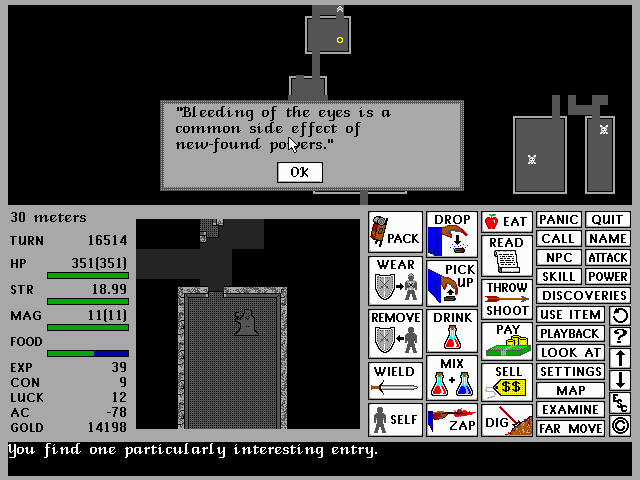
  • Something weird happened with my strength. For a long time, it was stuck at 18.99, and I figured that was the highest, but at some point it rolled over to 19-something and has been continuing to grow towards 20 ever since.
  • At some point, I acquired the "Psi Blast" power. I have no idea when it happened or why. It doesn't seem to do very much damage.
            
When I hit Level 20, I got the "Fletching" skill, which allows me to make arrows out of woods. Since "Terraforming" allows me to turn any square into woods, I basically have all the arrows I want. Anyway, I took the game's offer to change classes and changed to a conjurer. I spent 20 levels as a conjurer, skipping the first offer to change, because I hardly gained any spells. Even after 20 levels, I can only cast "Set Recall" (which only helps if you have a Scroll of Recall), "Reflect," "Draw Life," and "Illusory Self."
        
Casting spells. I thought I'd have cooler spells.
        
At Level 40, I changed to a blacksmith. Somewhere along the way, I read a couple of Scrolls of Knowledge and obtained the "Fennling" skill, an extremely useful skill that lets you combine the charges of two wands of the same type. I also got "Relocation," which lets me teleport on demand, "Ironworking," and "Taming." I haven't really experimented yet with the latter two. 

When I was done exploring, I went back to the Temple of Vidur. He still killed me instantly, but this time I had one new item: a Wand of Death. It only had two charges, but one of them took care of Vidur nicely (unfortunately, not before he killed my new companion, whose release so enraged Vidur in the first place). Gungnir was on his body, and apparently I'm too weak to wield it.
         
The first god falls.
       
I headed back to the surface and found the forest absolutely swarming with monsters. They're low level, and no danger, but they're so thick that I can barely move. Thankfully, my teleportation abilities get me through. They seem to respawn as fast as I kill them. I wondered if Ragnarok had started while I was in the dungeon or whether carrying Gungnir brings the to me.
            
My reputation must have taken a hit while I was underground.
          
While I was in the forest, I happened to note an icon I hadn't seen before. I (L)ooked at it and the game told me it was Thokk, the giantess who refused to cry for Baldur, meaning I'd have to bring her soul to Hela to get Baldur out of hell. I slipped on my Ring of Soul Trapping and killed her with a single blow. I made the mistake of not taking off the ring afterwards, and her soul was immediately replaced by the new slain enemies'. That required me to reload a significantly older game and replay Vidur's temple again. The second time, I found Thokk in the same area and took off the ring after capturing her soul.
        
Part of one quest down!
        
Lacking guidance on exactly where to go, I escaped the monster hoard by jumping through a portal. It took me to Slaeter's Sea and some other outdoor maps that kind of wrap around the opening forest, including the River Vid and the River Gioll. I can just stroll across the water because I have Skidbladnir (the magic boat) in my pocket.
           
The River Vid is mostly water.
        
I soon found out that if you go the wrong way out of these areas, you wind up in the open ocean and you immediately get attacked by Jormungand. The first time I found him, he damaged me for -60302 hit points. (I had a maximum of 452 at the time.) I tried the Wand of Death on him but it didn't work. He's also inescapable. I suspect you're just not meant to go into these areas.
          
I suppose if I could kill Jormungand, I wouldn't need to do anything else.
        
But there's an enemy that roams the rivers and lakes of this "outer rim" that's almost as deadly as Jormungand: the lorkesth. He gets like 5 attacks per round and does massive damage. He's the reason I can't just blithely stroll through the areas (the other enemies are relatively easy at my level). I have to watch very carefully for their appearance and use my teleportation ability to get to a safe square of land. There's no outrunning them, since they can move three times for every move I make. If I stand one square away from the water, I can defeat them with throwing weapons and wands, but like any monster they may auto-generate at any time. If I get another Scroll of Extinction, they're going to be strong candidates.
         
I like to think I'm skipping these shurikens along the water.
          
To the west, the world ended at the Bifrost. (Which I have been unable to take seriously since I discovered it's properly pronounced "beef roast," although I think it's cool that the Norse conceived it as a rainbow. So many things in mythology are dark and dreary.) I figured it was too soon to go to Asgard, so I went the other way. Mapping in this game is complicated; I'll explain more thoroughly in my next entry. Suffice to say that the particular section of maps I was in ended to the west at the Bifrost and east at the River Gioll. The Gioll map had some patches covered in fog and a river swarming with lorkesths, but oddly no other enemies or items on the map. For some reason, my Ring of Locus Mastery doesn't work, meaning when I teleport, I just teleport to a random place. Something is also causing me to teleport frequently even if I take off my Ring of Relocation.

In the middle of a patch of fog on the east side, I ran into a character named Harbard. He was rooted in place and didn't pursue me, but if I walked up to him, he killed me in a couple of blows. So I stood a couple squares away from him and hit him with the second and last charge in my Wand of Death. His body disappeared in the fog, but when I walked and stood upon it, the game told me that there was a staircase. Taking it led me to Niflheim.
          
Hell looks a lot like Maine in April.
         
I immediately had one of those moments that I described in the opening. I had been killing fire dragons and frost dragons in single blows, so I wasn't bothered by the "hel dragon" heading in my direction--not, at least, before he killed me in one attack that left me with -1,006 hit points.
             
My brief foray into hell.
         
Upon reloading, I tried again, taking pains to avoid the dragon, and I did come across some luck when I stumbled on a Wand of Wishing with three charges. I immediately wished for another Wand of Death, and while it worked fine against the next hel dragon, it did nothing against the unique enemies of the area, including Konr Rig and Plog. I reluctantly returned to the surface and decided to try again when I was stronger, although given the fact that I've already maxed in most of the game's classes and I have incredibly powerful equipment and near-max strength (I assume, since it's now going up by decimals instead of integers), I don't know what "stronger" is going to look like.

Still, I moved north from the River Gioll to what turned out to be the mountainous realm of Jotenheim. I expected to meet a lot of giants but mostly found the same creatures from previous areas, including a lot of faleryns, who fortunately didn't seem to be as interested as replicating as they were in the dungeon. Teleport control still doesn't work, which makes it hard to explore systematically.
        
The transition to Jotenheim.
       
After I cleared most of the map, there remained an impenetrable rectangle of mountains and trees. Figuring it must hold something interesting, I used my "Terraforming" ability to change a tree into regular ground. Inside the rectangle was a small building populated by a large foe named Gymir. He had the decency not to kill me in a single blow, but his attacks were capable of doing more than 100 damage each. I quaffed a Potion of Speed and a Potion of Curing and proceeded to kill him in legitimate combat. He left behind Mimming, Freyr's sword. I'm too weak to wield it.
          
My character doesn't just chop down trees; he changes the very nature of the landscape.
          
Jotenheim continued for two maps to the north. To the north of that was "Mimer's Realm," a map of mountains, lava pools, and fog. A new monster called "iridorns" were introduced. They can kill in a single hit by ripping off your head, although they die pretty easily if you can strike them first.
          
With Mimer's Realm, I found Mimer's Well, mentioned in the backstory as the residence of the serpent Aspenth, the transformed version of Gjall, Heimdall's horn. But I need the "Swimming" ability to navigate there and I don't have it yet.
           
My character at the end of this session.
          
At some point, while exploring Jotenheim, Heimdall's voice bellowed from the sky:
              
O great heroes of the world! I must have Gjall to rally the forces of good. Time begins to grow short. The sea rages with the anger of Jormungand. The earth quakes mightily. Loki seems ready to burst his bonds. The moon and sun shall soon be swallowed by the mighty wolves Fenrir and Garm. Surtr is honing his sword of destruction. The evil ones are gathering their forces.

To speed you in your quest, I will use my powers over nature. The lesser creatures of the realm shall grow weary and despair. They shall no longer wish to battle against your might.
              
This announcement suggests the game has a time limit (and also that Heimdall just removed my ability to easily grind). I'm going to explore to the north a little further, but if nothing pans out, I'll use my Wand of Wishes for Scrolls of Knowledge and see if I can pick up the swimming ability. At this point, I have three of the six quest items. If I can get one more, it might be worth heading to Asgard.


Time so far: 15 hours

*****

B.A.T. II: The Koshan Conspiracy was going to be next, but I'm not sure how it got on my list in the first place. None of my sources call it an RPG, not even a hybrid. I can't find evidence that any commenter defended it as an RPG. I'm dumping it unless someone can make a persuasive case. The Adventure Gamer already covered it if you really need to read about it.

That means we get to our first random roll for the next game on the list! Pulling up the list, adding a "Random" column, filtering out games I've already played or rejected, we get . . . Xenus II: White Gold (2008). But of course I'm not going to play a game before its predecessor, which in this case is Boiling Point: Road to Hell (2005). That's also the first game on my list from Ukraine. I can't find mention of any other necessary precursors. But I'm just kidding because I'm not going to let myself jump that far ahead in one go. The actual next game needs to be in the next year I have not yet played, and a random selection from that year brings us to Shadowkeep 1: The Search by the same author as the Bandor series. Meanwhile, Planet's Edge gets moved up a notch to Game 358, but I'm having trouble with that one. DOSBox crashes every time I try to leave the intro screen. So the real next game might be Ishar while I try to solve that problem.

2020年2月21日金曜日

There's A Dinosaur Cloning Game For Everyone

Crowdfunding, pre-orders and limited print runs are rapidly becoming the standard for game publishing, and it is because of this that I had to decide whether I wanted DinoGenics before I was able to play Dinosaur Island. Based only on information from their respective crowdfunding campaigns the two games look very similar, and honestly, how many dinosaur cloning games does one person need?

If I'd been looking at both games at the same time I most likely would have only chosen one, and that one would have been DinoGenics, based on its more conventional illustrations and graphic design -- the obnoxious look of Dinosaur Island remains one of the few things I don't like about the game. Unfortunately (or perhaps fortunately) I had to make a decision on DinoGenics after I had committed to buying Dinosaur Island, so I ended up with copies of both games. In the end I'm glad I did.

The two games are similar in that they are both worker placement games about building a zoo filled with cloned dinosaurs, but that's where the similarity ends. DinoGenics is a much more traditional worker placement game, with players competing for spaces on the board so they can get the resources they need to clone dinosaurs, build appropriate enclosures for them, and add enough support buildings to accommodate an increasing number of guests. And don't forget to feed those carnivores, or they'll break out of their enclosures and you'll likely spend a lot of your next turn making repairs...

The game design is solid if not overly innovative, but where DinoGenics really shines in in the quality of its components. The graphic design is excellent and does a much better job of evoking Jurassic Park than the much more stylized Dinosaur Island. The meeples are wood rather than plastic (in my opinion plastic meeples are a disturbing trend in game publishing and a scourge upon mankind), done in very nice greens, browns and greys that make it easy to tell the different types of dinosaurs apart. The cards and tiles are sturdy with high quality printing -- the only thing I don't like is that some of the text on the building tiles is very small and difficult to read.

If I had to choose between DinoGenics and Dinosaur Island, I would probably choose DinoGenics, although I do think the game play in Dinosaur Island is a bit more innovative. In the end the games are different enough that I'm happy to have both in my collection.

Rating: 5 (out of 5) This game features more traditional worker placement style game play than its competitor, but the much more lavish graphic design more than makes up for it.